
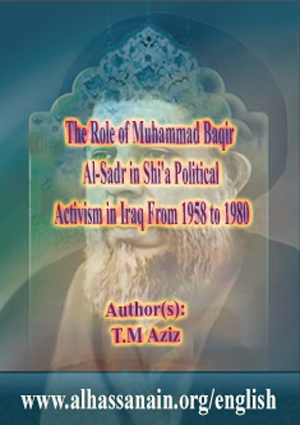
The Role of MuhammadBaqir Al-Sadr inShi'a Political Activism in Iraq From 1958 to 1980
By T.M Aziz
www.victorynewsmagazine.com
www.alhassanain.org/english
Published on7th January, 2003 (4thZhul Qa'dah , 1423).This work was written by T.M Aziz and was contributed to Victory News Magazine byMr A.GKarim . Editing and design byZaynab El-Fatah. Technical work provided byS.Abidin
©All rights reserved 2008. VictoryNewsMagazine.com
Notice:
This workis published on behalf of www.alhassanain.org/english
The typingerrorsaren’t corrected.
Table of Contents
Dedication: 5
Chapter One: Sadr is Executed 6
Chapter Two: The Rise of Sadr 7
The Communist Party 7
Chapter Three: al-Hawza al-’ilmiyya (Religious Academy) 8
Al-Hakim's Fatwa Identifying Communism With Atheism 8
Falsafatuna (Our Philosophy; 1959) and Iqtisaduna (Our Economics; 1961) 8
Chapter Four: Back to Hawza 10
Mujtama’una (Our Society) 10
Planned Establishment of Western-style Universities 10
Usul al-Din College in Baghdad 11
Chapter Five: Golden Era For Modern Shi’a Politics 12
Chapter Six: Confrontation with the Ba’th Party 13
Ayatullah Khomeini Not Executed by Shah of Iran 15
Chapter Seven: Ashurra Commemorations Banned 16
Chapter Eight: Encounters with the Ba’th Party: The Final Episode 18
Sadr Issues Fatwa Against The Ba'th Party 19
Chapter Nine: Sadr Detained- Bint Al-Huda Gives Fiery Speech 20
Chapter Ten: Sadr Interrogated 21
Security Forces Come For them Both 22
Conclusion 23
Sadr Was Dragged into Public Opposition 23
References 25
Dedication:
This workis dedicated to the memory ofShahid MuhammadBaqir Al-Sadr and his Sister,Shahidah Amina bint al-Huda who were both executed in the name of God's religion.
Chapter One:Sadr isExecuted
On April 8, 1980, MuhammadBaqir al-Sadr was executed . His execution aroused no criticism from the West against the Iraqi regime, however, becauseSadr had openly supported theAyatullah Khomeini’s regime in Iran and because the Westwas distracted by the turbulence in Iran that followed the revolution. Governments both in the West and in the region were concerned that the Iranian revolution would be “exported,” and they set about eliminating that threat. WhenAyatullah Khomeini called upon Muslims in Iraq to follow the example of the Iranian people and rise up against the corrupt secularBa’thist socialist regime, they interpreted it as the first step in the spread of Islamic radicalism that would eventually lead to thedestabilisation of the whole region.
Sadr’s support of the Khomeini crusade against theBa’thists was considered a threat to the Iraqi regime and dealt with swiftly . Thousandswere arrested , and hundreds were executed without trial.Sadr as the head of a movement that had gained popular support from the success of the Iranian revolution, emerged as an anti-governmental leader and a catalyst for anti-Ba’thist activity, and was regarded by his followers as the “future Khomeini” of Iraq.(1) TheBa’thist regime decided that he had to be eliminated if the regime was to survive.Sadr’s execution, hence, was the act of an authoritarian regime fighting for its survival.
What made political Islam such a grave danger to the regimes in the area was not simply its popular appeal, but also the grassroots organizations that embraced its principles and political slogans.In almost all Middle East countries Islamic political groups had, since the turn of the century, been bent on achieving their principal goal of establishing a state based on the principles and teachings of Islam, and these very organizations had paved the way for the victory of the revolution in Iran,(2) Khomeini also found in them both the means and the political muscle to export Islamic revolutionary ideas to the rest of the Middle East.
Some of these organizations, including the IslamicDa’wa Party which Sadr founded, had existed in Iraq before the Islamic revolution in Iran and theBa’thist regime in Iraq.Sadr was also the mastermind behind a program that aimed to establish an Islamic state not only in Iraq,but throughout the Islamic world. The roleSadr played in theShi’a community in Iraq at large and his effort to counter the political acquiescence of the religious establishment and to confront the political oppression there made him theShi’a leader in that country. A detailed account of the events that led to the rise and fall ofSadr is therefore useful for placingSadr in the context of Iraqi politics in general and of the Islamic movement in particular.
Chapter Two: The Rise ofSadr
In 1958, a military coupd’etat began a period of great turmoil in Iraq that changed its political system and social fabric.The kingdom that had been engineered by British occupation forces in 1921, was replaced by a “republic” under the rule of a military junta ; the royal family and the ruling class were executed. The head of the military junta, GeneralQasim , who had led the revolt gained popular support unprecedented in modern Iraqi history, in part because of his policy of dissociating Iraq from Britain, which included withdrawing from the CENTO alliance known as the “Baghdad Pact” and closing British military bases in the country.(3)
The Communist Party
With the coup in place, a variety of political groups sought a place in the new regime, and in the process created anarchy. Some, of which the Communist Party was the best organized, were given a voice in the new regime. To increase his power base in the country,Qasim used the Communists to eliminate his colleagues in the ruling junta who were loyal to the Arab nationalist movements. In the bloody street fighting that followed, especially in the northern cities of Mosul and Kirkuk where the nationalist officers attempted a military coup againstQasim , the Communists emerged as the major political force.(4)
TheShi’ia religious establishment, acquiescent since its last revolt against the British in 1920, found itself challenged by atheist political forces who, if left unchecked, might wipe Islam from the lives of the people,(5) for the nation seemed to be welcoming the secularism and antireligious sentiments of the new regime and to accept Communist propaganda, which denounced the religious establishment as reactionary and religion as an obstacle to modernization and the progress of the people. The Communist forces then began to penetrate the religious establishment itself in the holy cities of Najaf, Karbala, andKadhimiyah , even recruiting members of religious families, but the religious leadership (marja’iyya ) under the GrandMujtahid Muhsin al-Hakim took steps to overcome these challenges.
Chapter Three: al-Hawza al-’ilmiyya (Religious Academy)
TheShi’a religious establishment in the al-Hawza al-’ilmiyya (religious academy)was divided between traditional scholars who advocated indifference or aloofness from politics and activists who advocated involvement. The latter organized themselves into theJama’at al-’Ulama ’ in Najaf(6) to counter antireligious trends in society.MuhammadBaqir al-Sadr was at that time a young scholar and was not considered an official member of theJama’at al-’Ulama ’ which was made up mainly of elders and well-knownmujtahids .(7) He was able, however, to exert influence on the group through his father-in-lawShaykh Murtaza AlYasiyn , who was acting president of the group, and through his older brother, Ismail al-Sadr , amujtahid who held a senior position in theJama’at . (8)
According toTalib al-Rifa’i , theJama’at al-‘Ulama ’ had as its immediate objective countering the Communistchallenge to Islam. In theirmanoeuvring , they were realistic enough to appease the popularQasim ; in their public leaflets and announcements, they supported him while attacking the Communists. As a reward, theQasim regime gave them access to the government-controlled radio. The weekly public statements of theJama’at al-’Ulama ’ were written bySadr and delivered byHadi al-Hakim.(9)
Al-Hakim's Fatwa Identifying CommunismWith Atheism
This appeasement did not last long. Conflict between the religious leadership andQasim erupted whenAyatullah Muhsin al-Hakim issued a fatwa that identified Communism with atheism and forbade Muslims from joining the Communist Party or helping its cause. The fatwa embarrassed theQasim government and forced GeneralQasim to abandon the Iraqi Communist Party.Qasim made several requests to visitAyatullah Hakim, but the latter refused to meet with him until he had abrogated the civil-liberties’ law, which violated the Islamic codes of inheritance.( 10)
For two years during the appeasement period theJama’at al-’Ulama ’ had been given permission to publish a monthly journal al-Awa’ (the Lights), whose objective was to counter the intense secular and antireligious propaganda that had followed the 1958 revolution.According toTalib al-Rifa’i ,Muhsin al-Hakim had suggested it, but since it was not acceptable for amarja ’ to sponsor a political publication, theJama’at al-’Ulama ’ was asked to assume the task.(11) Sadr wrote its editorials, which he used to outline the basic political program of the Islamic movement,(12) and in the process discovered that he had a talent for writing persuasively.
Falsafatuna (Our Philosophy; 1959) andIqtisaduna (Our Economics; 1961)
During the same period,Sadr published his first philosophical study,Falsafatuna (Our Philosophy; 1959),(13) a critique of communism, the materialist school of thought, and dialectic materialism, in whichSadr argued, that communism had too many flaws and shortcomings to be considered the final truth for mankind. It could not be the answer to society’s problems because its basic assumptions were false,Sadr contended. His second work,Iqtisaduna (Our Economics; 1961), criticized the economic theories of communism and capitalism and introduced an Islamic theory of political economy in an effort to counter the argument by secularists and communists that Islam lacked solutions to the problems of man in modern time.Sadr’s major task inIqtisaduna was to show that Islam was concerned with man’s economic welfare. Infact his major intellectual achievement was his formulation of an Islamic economic doctrine based on Islamic law; he was the first to do so.
Sadr and his colleagues also confronted the secular forces on a third front through the establishment of theDa’wa Party. According toTalib al-Rifa’i , itwas founded byMahdi al-Hakim, al-Rifa’i and another, unknown, person. Al-Rifa’i later introducedSadr to the party leadership, andSadr eventually became its head,( 14) playing an important role in setting party structure and doctrine,(15) and later its supremejurisconsult (faqih al-hizb ). Even the name of the party,Da’wa (“Call”), was said to beSadr’s idea.( 16) The aim of theDa’wa was to organize dedicated Muslim believers with the goal of seizing power and establishing an Islamic state. To achieve that goal it would indoctrinate revolutionaries, fight the corrupt regime, and establish an Islamic state; then it would go on to implement Islamic laws and export the Islamic revolution to the rest of the world.( 17) This grand plan was said to beSadr’s idea. The first stage had to be clandestine to secure the party against a crackdown, so the partywas organized in a hierarchical multi-branch cell structure. Its activities were not to be limited to Iraq only, but were to go on in otherShi’a communities around the world. To that end, branches were secretly formed in the Gulfstates and in Lebanon; attempts to form them in Iran were unsuccessful.
Chapter Four: Back toHawza
By 1960,Sadr was one of the leadingmujtahids in the religious school of Najaf with a distinguished reputation in jurisprudence (fiqh andusul al-fiqh ).His seniors in theHawza therefore advised him to give up his political role in theDa’wa party and on the Awa’, which were detrimental to his leadership in theHawza and prepare himself for becoming the future grandmarja ’ of theShi’i (thehawza would not accept an activemujtahid for the position of grandmarja ’ , at least not a member of a political party).(18) Themarja ’ is usually selected from among the leadingmujtahid in thefiqh andusul al-fiqh , and the candidate has to prove his capacity in these areas by using the Socratic method in his teaching and by publishing his legal opinions. Since being appointed depended on the approval of the teachers andmujtahids in theHawza , the prospect ofSadr’s becoming the grandmarja ’ of allShi’as was in jeopardy so long as he continued to be politically active. Although pressure onSadr to give up his political activities seemed to come mainly from the formermarja ’Muhsin al-Hakim, many factions in theHawza were critical ofSadr’s activism. Led by Hussein al-Safi,( 19) a public campaign was launched againstSadr depicting his activities as harmful to the survival of theHawza .(20) A group in theJama’at , influenced by the propaganda againstSadr , began to show their dissatisfaction with him as well.(21) Sadr’s editorials in al-Awa’ also raised a disturbing question: they were subtitledRisalatuna (Our Message), but the enemies ofSadr questioned whether they represented the views of theJama’at at all. Finally, in 1961Muhsin al-Hakim, through his sonMahdi , persuadedSadr to give up his post asfaqih of theDa’wa party and as editor of Awa’.(22)
Mujtama’una (Our Society)
After his resignationSadr confined himself to the traditional way of life of theHawza , avoiding activities that might jeopardize hismarja ’ status . He even delayed the publication of his long awaited book,Mujtama’una (Our Society) because, according to some sources, the time was not ripe for it.(23) According to members of theDa’wa party, however,Sadr kept in touch with the party through one of his pupils.(24) As for the Awa’,Fadlullah notes thatSadr encouraged him to write its editorials.(25)
Planned Establishment of Western-style Universities
Sadr’s passion for reformwas now directed toward thehawza itself.First it was necessary to modernize its curriculum: for the past century and a half, Najaf’shawza had emphasized onlyfiqh andusul al-fiqh because that was what Najaf was noted for; other Islamic studies were considered minor or unimportant, and thehawza’s teachers paid little attention to them.Sadr was also uneasy over the irregular attendance of the students and their neglect of their studies. He felt that students must complete their courses with distinction before they could claim to be religious scholars (‘alim )(26) and proposed a new textbookon the grounds that the old ones were not written for students. A textbook, according toSadr , must take into consideration the student’s ability to comprehend the subject only gradually from its basic concepts to its most recent development.Sadr’s plan embraced not only the use of textbooks of the sort used in modern academic institutions, but the establishment of Western-style universities that would hold the student responsible for completing certain courses and passing regular examinations.
Usul al-Din College in Baghdad
To implement his reforms,Sadr helped establish theUsul al-Din College in Baghdad in 1964 and set up its curriculum.(27) He later wrote three textbooks on the Qur’an, theusul al-fiqh , and Islamic economics for first and second year college students.(28) However, his efforts to carry out his reforms in theHawza itself faced stubborn resistance from both students and its antiquated establishment.
Chapter Five: Golden EraFor ModernShi’a Politics
The years 1964-1968 were a “golden era” for modernShi’i politics, first because theBa’thist-Arif regime felt indebted to theShi’a religious establishment for its help in discrediting and oustingQasim’s regime and second because the new regime gained legitimacy from theShi’a leaders who supported their crackdown on Communist forces in the country (ironically, most of those prosecuted were alsoShi’as ). The relative freedom theShi’a enjoyed during that period resulted from the continuous struggle between theBa’thists andArif , between the Arab nationalists and the Communists, and among theBa’thists themselves. The regime was so preoccupied withthis internal fighting that it turned a blind eye toShi’a political activities, though later, it oustedShi’as from the few governmental posts they had gained underQasim .
Free from government interference, theDa’wa party increased its membership in the universities and among the intelligentsia. According toDa’wa sources, more than 1,500 copies of theDa’wa official, but underground, journal, theawt al-Da’wa ,were distributed to members and supporters in the University of Baghdad alone. Students showed their commitment in a march known as themawakb al-talaba (students’ procession) in Karbala at the annual commemoration of the martyrdom of the ImamHusayn . Al-Hakim expanded his influence by increasing enrolment in theHawza in Najaf and by developing plans to establish a Western-styleShica academy inKufa , where a college education would become available toShi’a youths who would someday be influential in political affairs.He also established new religiouscentres and libraries in several Iraqi cities directed by missionaries known aswukala ’ (representatives). The religious scholars of Baghdad andKadhimiyah organized an association, similar to theJama’at al-Ulama ’ in Najaf, known as theHay’at Jama’at al-Ulama ’fi Baghdadwa al-Kadhimiyah .(29)
Chapter Six: Confrontation with theBa’th Party
TheBa’th Party’s rise to power on July 17, 1968, started a new phase in the conflict betweenShi’a leaders,Muhsin al-Hakim and MuhammadBaqir al-Sadr , and the central government in Baghdad. The regime faced two leaders, whoboth had charisma and political clout, al-Hakim through his symbolic leadership of theShi’a worldwide, andSadr through his influence over theDa’wa . The stability of the new regime depended on withstanding them.Its first step toward limiting theShi’a’s power was to curtail their religious activities, which included the closing of theJawadayn elementary and high schools and theUsul al-Din college in Baghdad, confiscating the land and funds set aside for buildingKufa University, shutting down theRisalat al-Islam, the only religious journal the government allowed to be published at that time, prohibiting themawakb al-talaba in Karbala, expelling hundreds of non-Iraqi students from thehawza in Najaf, and issuing a law requiring Iraqis attending thehawza to join the armed forces.
TheShi’a leaders appeared tobe disorganized and theBa’th regime to catch them by surprise. Unaware of theBa’thist’s plan to eliminate the political structure of theShi’a community, its leaders met to figure out some peaceful means for dealing with the government and decided on a public protest. TheHay’at al-Ulama ’ suggested thatMuhsin al-Hakim visit Baghdad to mobilizeShi’a support against the government.(30) Al-Hakim took up residence inKadhimiyah to receive supporters;Sadr went to Lebanon to organize protest from abroad and use the office of theShi’a supreme council headed by his cousin Musa al-Sadr to campaign against the Iraqi government. Telegramswere sent by Musa al-Sadr to the heads of the Islamic states and Islamic groups calling attention to theBa’thist’s government harassment of the religious leadership in Najaf. The result of these efforts was disappointing. Only Nasser of Egypt, Faisal of Saudi Arabia,Iriyani of North Yemen, and theJama’at-i Islami of Abu al-A’la Mawdudi in Pakistan gave any moralsupport, and no one acted.
On his return to Iraq,Sadr , with the cooperation of theJama’at of Najaf and theHay’at of Baghdad andKadhimiyah , held a public meeting at the Imam Ali shrine in Najaf to support al-Hakim and condemn theBa’thist government action.The statement, which was delivered to the audience byMahdi al-Hakim, had been drafted bySadr .(31) The next step tobe taken against the government, according toMurtada al-Askari , was to organize a mass demonstration in Baghdad in support of al-Hakim.(32) However, before the plan was carried out theBa’thist government announced thatMahdi al-Hakim was plotting to overthrow the government in a military coup with the help of some generals andShi’a businessmen who had links to Iran and the West (by which they meant the United States and Israel).(33) This accusation put theShi’a leaders on the defensive and diluted their support. Mahdi al-Hakim was smuggled out of the country; al-Askari went to Lebanon; andMuhsin al-Hakim retreated to Najaf where he died a few months later. His successorAyatullah Khoei , the mentor ofSadr , refrained from taking any action against theBa’thist government.( 34)
AfterMuhsin al-Hakim died, theBa’th government intensified its efforts to reduce the influence of theHawza in Najaf by expelling its non-Iraqi students (the majority of students were foreigners) and monitoring the Iraqi students there. That threw the wholeHawza into chaos. To keep non-Iraqi students in the country so they could help resist the government,Sadr convincedAyatullah Khoei to issue an order (hukm ) to students to stay in Najaf and continue their studies.(35) Unwilling to antagonize the newShi’a marja ’ ,Ayatullah Khoei , who was considered to be above politics, theBa’th government postponed implementing its deportation policy. TheBa’thist regime then started to crack down on theDa’wa party. Many suspected members of the partywere rounded up in 1972 and sentenced to one to five years in prison .(36) SahibDakhiyl , known as Abu ‘Isam , died under torture in 1973.He was the organizer of the student procession held in Karbala(37) and was also believed to have been the head of theDa’wa party’s Baghdad branch.(38) A year later, about seventy-fiveDa’wa party members, some of them religious scholars, were detained by the security forces, and five, all of whom were believed to be leaders of theDa’wa party, were sentenced to death by the revolutionary court.(39) Sentencing these people, three of themulama ’, brought a public outcry and condemnation from the religious establishment, includingKhoei , Khomeini, andSadr .(40) In order to avoid a precedent for executing religious scholars of theHawza ,Sadr issued a fatwa forbidding students or scholars of theHawza to join any political party. Later that year,Sadr himself was detained by security forces and taken from Najaf to Baghdad for interrogation, but was soon released.(41)
In the post-Hakim era,Sadr was recognized in theHawza as amarja ’ and the heir-apparent of Grandmarja ’Ayatullah Khoei .(42) However, he was aware that themarja’iyya , theShi’as ’ only true source of political leadership, lacked adequate institutional underpinning, even though it was a thousand years old. In particular, it lacked the means of enforcing decisions on therank and file of ‘ulama ’. Additionally, themarja ’ traditionally made policies and arrived at decisions using an inner circle of close associates and family members to gather information, issue statements, and distribute religious funds. There was no formal procedure for making decisions or planning long-term strategy, and that often resulted in confusion that weakened the relationship between themarja’iyya and the people.
To enhance the power of themarja’iyya ,Sadr sought, as he put it, to transform what he called the “subjectivemarja’iyya ” into an “objectivemarja’iyya .” Themarja ’ , according toSadr , must conduct his affairs and guide his people using an organized structure. To conduct the affairs of theummah , themarja ’ should set up committees to manage educational affairs in thehawza , to support Islamic studies, research, and writing on essential subjects, to look after the affairs of the ‘ulama ’ who represent themarja ’ in other cities, to support the Islamic movement, and, finally, to administer financial affairs.
However, at that timeSadr was not ready to form the institutional structure of the “objectivemarja’iyya ” because he was not the suprememarja ’ , the symbolic authority for allShi’as , a position that would give him the financial and the religious power to carry out changes. The publication of his al-Fatawa al-Wadiha , a book on religious laws, was intended in a way to announce hismarja’iyya , and prepare himself and contenders in Najaf and Qum in the traditional manner to succeedAyatullah Khoei , the grandmarja ’Sadr also had a political motive behind his early indirect announcement of interest in themarja’iyya . He thought it would protect him from government prosecution.
Ayatullah Khomeini Not Executed by Shah of Iran
Once he was amarja ’,Sadr believed, the government would spare his life regardless of his political stand, because regimes in Iraq and Iran did not execute leading jurists. A case in point was the Shah’s decision not to executeAyatullah Khomeini after themaraji ’ in Qum issued a statement proclaiming that Khomeini as one of them.Instead the Shah expelled Khomeini from Iran.
In announcing hismarja’iyya ,Sadr somehow thought he was gaining political immunity. At the publication ofSadr’s al-Fatawa al-Wadiha , members ofDa’wa party andSadr’s admirers, mostly students and intellectuals, started referring to him as theirmarja ’ and leader.
Chapter Seven:Ashurra Commemorations Banned
In early 1977, theBa’th regime took the boldest step yet to curb theShi’a when it banned the annual ceremonies commemorating ImamHusayn’s martyrdom. The regime had tried but failed to prohibit them since 1970, especially in Najaf and in Karbala. That year, theBa’th leadership was determined to use any means necessary to stop the traditional procession from Najaf to Karbala, an event that generates considerable religiousfervour . Tens of thousands ofShi’a from all over Iraq participate in the pilgrimage, which usually takes four days to cover about fifty miles. The processionwas seen by the regime as hindering their policy of secularism and as providing the religious authorities with popular support.
Banning the procession in 1977 provoked riots in Najaf. Organizers distributed leaflets that called on people to participate in defiance of the authorities to protect their religious rights.(43) The public hearings organized by theBa’th Party and the governor of Najaf did not ease the tension but rather precipitated chaos.(44) An estimated thirty thousand people began their procession holding banners printed with verses from the Qur’an, such as “The power of God is above theirs” and “Victory shall come from God.”(45)
Faced with this defiance, the regime first met with the leaders of theprocession( 46) and sought the help of MuhammadBaqir al-Hakim, who informed theShi’a that the regime was willing to lift the ban on the procession if the rioters would stop chanting anti-government slogans. However, anti-Ba’thist sentiments ran so high by then that compromise was impossible. The government on its part mobilized a military brigade with tanks, helicopters, and fighter jets to block the way to the city of Karbala.(47) Hundreds of demonstrators were able to get into the city, however, because many officers and soldiers were sympathetic to the cause and were unwilling to obey the government orders to fire on people chanting religious slogans.(48) The government then mobilized theBa’th Party security and police to suppress the procession in the streets of Karbala and to detain as many people as they could. Hundredswere imprisoned , and many were injured.
The government then formed a special revolutionary court (makamat al-thawra ) headed by three high-rankingBa’th Party leaders to try the defendants.(49) Seven peoplewere sentenced to death and fifteen, including MuhammadBaqir al-Hakim, to life imprisonment. The incident also caused a split within theBa’th leadership itself. Some high-ranking members of the party judged the action unduly harsh and seemed hesitant to take strong action. An extremist group led by theBakr -Saddam factions won by expelling the moderate group, including the members of the Special Revolutionary Court, from their government and party positions.
The regime suspectedSadr of having had a part in the demonstration. Ithad been well organized , which suggested that theDa’wa Party was behind it. Al-Hakim, the head of the group who negotiated on behalf of the regime with the rioters, was a disciple and personal representative ofSadr . His failure to gain concessions from the rioters whose links were with theDa’wa , the mainSadr organization, was one of the signs that made the regime suspect thatSadr led a behind-the-scenes conspiracy. The regime’s security forces detainedSadr and sent him to Baghdad for questioning, but released him when the people demanded it in order not to instigate another riot by theHawza .
Chapter Eight: Encounters with theBa’th Party: The Final Episode
The leaders of theBa’th regime thought that their measures in 1977 had put an end to religious opposition for years to come, but the revolution in Iran in 1978 rekindled efforts against the Shah and a revolution led by religious leaders in Najafwas in the making. TheShi’a capital was again at centre stage; though this time the effortwas not directed toward theBa’th , it was still troublesome to the Iraqi regime.Ayatullah Khomeini, the leader of the Iranian uprising, had been living in Najaf for the past fourteen years. He took advantage ofBa’th enmity toward the Shah to launch a campaign against him in Iran. He was given access to Iraqi radio to beam his messages, andthis also made it possible for him to be approached by his political collaborators. However, suchfavours (which in any casewere severed after the Saddam-Shah Algiers agreement in 1975 that ended the hostility between the two regimes) did not elicit any pro-Ba’th sentiment from Khomeini. He had witnessed theBa’th’s oppressive measures toward theHawza of Najaf and towardShi’a leaders.
The revolution in Iran seemed to demonstrate that an oppressive regime run by awell entrenched security apparatus and supported by the Western intelligence could in fact be challenged and defeated, and that Islamic ideology was capable of leading the masses to establish the dreamed-of Islamic state. It showed that blood sacrificed during revolutioncan encourage other devotees of Islam’s cause. The oppressive measures of the regimecould be turned into the means for achieving victory. The revolution in Iran presented an appealing political scenario for Muslim revolutionaries to follow; the IraqiShi’a were the first to emulate it.
Sadr made several calculated but discreet political moves that would not antagonize the Iraqi regime but would show his commitment to and support for the revolution in Iran.( 50) He first sent a long statement to the Iranian people while Khomeini was in Paris, declaring his support and praising the uprising.(51) Then after Khomeini returned to Iran,Sadr sentMahmood al-Hashimi , one of his closest disciples, to Iran as his representative.(52) Both actionswere considered by the Iraqi regime as clear violations of the government’s “wait and see” policy.(53)
Furthermore,Sadr , contrary to theBa’th government policy of instigating and supporting the uprising of the Arab population in Iran, had asked the Arabs to support the Islamic state that eventually wouldfulfil their political and ethnic rights. In one of his messages to the Iranian people,Sadr called on the Arabs in Iran to obey the leaders of the revolution because the Islamic republic represented the state founded by the Prophet where people of different nationalities and ethnic background could live intranquillity .(54)
Sadr then published six essays that concerning the foundation of the Islamicstate which were later collected under the title al-IslamYaqwud al-Hayat (Islam governs life). One of them dealt with the religious basis for forming an Islamic government. In this treatise he outlined the structure of an Islamic state, the functions of each of its branches of government, the responsibilities of themarja ’ in the state, and the legitimacy of his absolute authority according toShi’a Islam. The treatise seems to have had a major impact on the authors of the constitution of the Islamic Republic of Iran. One can find many ofSadr’s ideas and views on the structure of an Islamic state in the final draft of that document. The other five essays dealt with the principles of the Islamic state and the structure of its economy, using ideas similar to thoseSadr presented in his works twenty years earlier, proof that he had conformed to his earlyijtihad .
Sadr Issues FatwaAgainst TheBa'th Party
Sadr’s boldest step against the regime was issuing a fatwa prohibiting Muslims from joining theBa’th party or its affiliated organizations, a step so dangerous that even some ofSadr’s representatives in various Iraqi cities hesitated to publish because they feared for their own safety and forSadr’s survival. To make its contents known,Sadr resorted to means such as encouraging his students to ask him questions during his regular sermons in theHawza regarding participation in theBa’th party. Afterthat people expected a severe step to be taken againstSadr , but relations betweenSadr and the regime remained under control. Instead, the last strawwas added by Iran.
Ayatullah Khomeini, relying on his sources in Najaf, broadcast a message toSadr calling on him to stay in theHawza and not to leave Iraq despite government harassment.(55) AlthoughSadr was facing detainment or possibly execution, he was not in any case planning to leave Iraq.(56) Khomeini’s message andSadr’s response,(57) whichwere heard by millions in Iraq, set off a wave of public demonstrations in several Iraqi cities in support ofSadr and in praise of Khomeini. Najaf was the most turbulent; there delegations from all over Iraq came to hold demonstrations and tobe received bySadr .Sadr told his followers to call the demonstrations off; since they represented the core of his support,Sadr did not want them exposed to the regime and needed to secure their protection from future government crackdowns.(58) He told one of theDa’wa’s members that “the regime’s quiescence for the moment reveals a great hidden danger; thus we should use precautions and prudence in our action.”(59)
Chapter Nine:Sadr Detained-Bint Al-Huda Gives Fiery Speech
Then the government, asSadr anticipated, began to crackdown:Sadr’s representatives and hundreds ofDa’wa memberswere rounded up and imprisoned or executed . ThenSadr himselfwas detained and taken to Baghdad . His sister,Amina al-Sadr , known asBint al-Huda, went to the holy shrine of Imam Ali ('a) and gave a fiery speech urging people to demonstrate against the government and to protect their leader. As the news of his arrest spread, riots broke out in Baghdad, Basra,Diyala ,Samawa ,Kuwt ,Diwaniyya , Karbala, and other cities. The bazaar in Najaf closed down; angry crowds clashed with the police. The whole city seemed under siege as the government increased its security efforts. The spread of violence in the country forced the regime to freeSadr the next day.
The detention ofSadr gave theBa’th regime a clear idea of the extent of his support. His opposition to the regime had made him a national leader and agalvaniser of popular opinion, and his presence had become a threat to the survival of the regime. TheBa’thists therefore determined to cut him off from his allies, his ‘ulama ’ and the rank and file of theDa’wa party. Muslim activistswere arrested en masse, tortured, and executed, and the mosques the ‘ulama ’ served were shut down. Even some prominent ‘ulama ’who usually cooperated with the regime and supported its policy were detained. The policy of theBa’thist regime was not to spare any effectiveShi’a religious forces in the country. Government documents show that the Revolutionary Court passed at least 258 death sentences out of twenty-two trials.(60)
Chapter Ten:Sadr Interrogated
Sadr himselfwas placed under house arrest, which the regime tried to extract concessions from him. During his interrogation ofSadr in August 1979,Fadil al-Barak, the head of the security agency, demanded that he make a public statement denouncing the Iranian Revolution and supporting the Iraqi policy toward Iran.WhenSadr refused the regime softened its language, and a new mediator,Shaykh Isa al-Khaqani , was sent to askSadr tofulfil only one of five conditions to spare his life: withdraw his support ofAyatullah Khomeini and of the Iranian regime; or issue a statement supporting one of the government’s policies such as the nationalization of foreign oil companies and national autonomy for the Kurds; or issue a fatwa forbidding association with theDa’wa party; or revoke the fatwa that prohibited joining theBa’th party; or be interviewed by an Iraqi or other Arab newspaper that was affiliated with the Iraqi regime. By thenSadr , according to his personal secretary al-Nu’mani , had concluded that his dayswere numbered any way, and he decided to reject all government demands in anticipation of his martyrdom. He told al-Khaqani , theBa’th regime’s mediator:
“The only thing I have sought in my life is to make the establishment of an Islamic government on earth possible. Since it has been formed in Iran under the leadership of Imam [Khomeini] it makes no difference to me whether I am alive or dead because the dream I wanted to attain and the hope I wanted to achieve have come true, thanks to God.”(61)
When the Islamic fundamentalist groups, theDa’wa party and Islamic Action Organization headed by al-Shirazi and theMudarisi brothers,(62) saw the regime harassing their leader, they took up arms against theBa’th officials. They attacked theBa’th party ideologue Tariq Aziz (then the foreign minister) inMustansiriyya University. Aziz was supposed to deliver a speech to theBa’th party members among the university’s student body stating the regime’s policy towards Iran. Muslim activists threw a bomb at Aziz, injuring him and killing his bodyguards. At the public funeral for theguards another bomb was thrown at the funeral procession, killing several people.(63) The regime faced for the first time resistance that was undermining its support among theShi’a . Saddam Hussein, by then the new president of the republic, during a hospital visit to those whohas been injured atMustansiriyya , called for revenge against the perpetrators. The regime’s old tactic oflabelling the Muslim armed struggle as the work of Iranian elements in the country was no longer convincing because Muslim anti-government activities continued to flourish even after more than 130,000 Iraqis of Iranian originhad been deported to Iran. Moreover,Sadr , the symbol of the Islamic movement, belonged to a well-known Iraqi family. What theBa’th regime needed was to liquidate the Islamic movement altogether. On March 31, 1980, the Revolutionary Command Council passed a law sentencing all past andpresent members of theDa’wa party or its affiliated organizations, or people working for its goals, to death. That law eliminated any possibility of sparingSadr’s life.
Sadr had in any case left no room for retreat. While he was under house arrest, he smuggled three messages to his associates calling on the Iraqi people to resist the regime in any way possible.(64) In these messages, he spoke as their leader in their name, and he demanded from the government political and religious rights for all people,Shi’as and Sunnis, Arab and Kurds. He even appealed to the members of theBa’th party, whose leader he accused of violating the principles of the party itself. He challenged theBa’th leadership to allow the people for only one week to express their hostility to the regime. In one of these messages,Sadr issued an ultimatum: topple the regime and establish an Islamic government in its place:
“It is incumbent on every Muslim in Iraq and every Iraqi outside Iraq to do whatever he can, even if it cost him his life, to keep the jihad and struggle to remove this nightmare from the land of beloved Iraq, to liberatethemselves from this inhuman gang, and to establish a righteous, unique, andhonourable rule based on Islam”.(65)
Security Forces Come For themBoth
The security forces came forSadr and his sister on April 5, 1980, and detained them in the headquarters of the National Security Agency in Baghdad. Three days later, his body was brought back to hisuncle MuhammadSadiq al-Sadr in Najaf for secret burial. The whereabouts ofBint al-Huda, his sister,were never disclosed by the regime, but it is widely believed that she too was executed.(66) Two weeks later,Ayatullah Khomeini announced the execution ofSadr and his sister and called on the Iraqi people and the armed forces to overthrow theBa’th regime.
Conclusion
Sadr’s involvement in politics in his early life was fortuitous and not, inmy view, the result of an overall plan on his part. HereI differ with the conventional wisdom of the revolutionary Islamists who claim the opposite.Sadr , as a young student and scholar of jurisprudence, was dedicated entirely to his religious studies; he took no part in political affairs after the 1958 coup in Iraq. His involvement in politics was a result of the encouragement of his colleague and friend,Talib al-Rifa’i , who introduced him to the founders of theDa’wa party.(67) They in turn saw in him the means tolegitimise their political activities within the non-politicalHawza of Najaf, because of his reputation there. However, once he became engaged in the activities of the party, hewas regarded as itsfaqih , a position entailing supervision of all its activities. His intellectual attainments, admired by the insecure religious establishment of that time, especially after the publication of his work,Falsafatuna , made him the party’s ideologue. Later, he became the religious leader of the Islamic movement that spread out of Najaf to a large part of the Muslim world.
His sudden resignation from the party did nothing to reduce his influence. Infact it was in part intended to open the way to the leadership of theShi’a community, i.e., themarja'iyya . Activist Muslim jurists and the Islamic movement were hoping thatSadr’s elevation as suprememarja ’ would help spread their mission andpoliticise Shi’a everywhere. It seemed to them only a matter of time beforeSadr would assume themarja’iyya , since he was indisputably a resourceful jurist of theHawza and “the jewel of the religious schools,” according to Khomeini. It was possible, many thought, that the political acquiescence of themarja’iyya could be ended .
Sadr Was Dragged into Public Opposition
In his final two years,Sadr was dragged into public opposition to the regime by the Iranian leadership and by those in Iraq, especially in theDa’wa party and amongSadr’s close associates who influenced by the Iranian revolution. He did not believe the time was ripe; “the objective conditions,” to use his terminology, were not in place. According to al-Nu’mani ,Sadr was not pleased when theDa’wa organized a public procession to show their allegiance to him, because it would expose its members and supporters to government persecution. IfSadr had felt that conditions had reached a revolutionary stage, he would not have anticipated the regime’s repression. However, the Iranian leaders went ahead with their public campaign; in their Arabic broadcasts to the Iraqi people, they asked them to followSadr and topple theBa’th regime.(68)
They encouraged Islamic political organizations in Iraq to organize demonstrations and protests similar to those used by the Iranian revolution in which people shouted slogans claiming the spiritual leadership ofSadr . This putSadr in an awkward position: to support the masses who were calling for his leadership he would betray his own convictions. As a religious jurist, he was constrained to side with those people who needed his guidance and demanded his leadership against tyranny. Hewas probably never consulted by the leaders in Iran or of the Islamic movement in Iraq. Evidently, he simply heard the messages ofAyatullah Khomeini and other Iranian leaders urging him to revolt against the government on the radio. Some of the earliest public protests and demonstrations in his support by the Islamic organizations were also spontaneous, started by enthusiastic supporters galvanized by the spectacular success of the revolution in Iran.(69)
Later theDa’wa party welcomed these demonstrations, and put pressure on themarja’s in Najaf (Khoei andSadr ) to initiate a movement likeAyatullah Khomeini’s in Iraq.(70) The leaders of the party concluded that conditions were ripe to start the revolution against theBa’thist regime. The Iranian experience showed them that if public demonstrations were large enough the regime could not crush the multitude of protesters. Their mistakes were overestimating the revolutionary frame of mind of the masses in Iraq and assuming that theBa’th regime would react to public protestlike the Shah had. For thosemiscalculations Sadr and his followers paid a deadly price.
References
1. IslamicDa’wa party,Istishhad al-Imam MuhammadBaqir al-Sadr minMandhur Hadhari , (n.p , 1981), pp. 36-37.
2. These groups includedFedaian Islam founded byNawab Safavi in the late 1940s and later headed bySadiq Khilkhili , the head of the revolutionary courts in 1979-80;Mujahidiyn Khalq , a Socialist Islamic organization supported by the lateAyatullah Talaqani ; andNahzat Azadi , a liberal-Islamic group, founded byMahdi Bazargan , the first prime minister of the revolution appointed byAyatullah Khomeini.
3. For a full account ofQasim’s regime, seeUriel Dann , Iraq underQassem (New York:Praeger , 1969).
4. On the influence and the atrocities of the Iraqi Communist Party (ICP), see U.Zaher , “The Oppression,” in CARDRI (Committee Against Repression and for Democratic Rights in Iraq), ed., Saddam’s Iraq, Revolution or Reaction?, (London: Zed, 1986), pp. 148-50.
5. HassanShubar , “Dawr Hizb al-Da’wa al-Islamiyya fi al-Taghyir wa-Halat al-Istirkha ’ al-Sabiqa ,” al-Jihad, 363 (October 24, 1988),8 .
6. According toTalib al-Rifa’i , a colleague ofSadr and a well-known jurist activist in the 1950s and 1960s,Jamat al-Ulama ’ consisted of tenmujtahids :Murtada AlYasiyyn ,Abbas al-Rumaythi ,Isma’il al-Sadr , MuhammadTahir Shaykh Radi , MuhammadJawad Shaykh Radi , MuhammadTaqi Bahr al-Ulum , Musa Bahr al-Ulum , MuhammadReda al-Mudhaffar ,Husayn al-Hamadani , and MuhammadBaqir Shakhs .
7. Interview with MohammadBaqir al-Hakam , al-Jihad 5 (Summer , 1980), 7-9.
8. MuhammadHusayn Fadlullah , “Taqdim , preface to MuhammadBaqir al-Sadr ,Resalatuna (Beirut: al-Dar al-Islamiyya , 1981), p. 16.
9.An interview with one of the leading figures in theJamacat al-Ulama ’ and theDa’wa party, in January 1, 1990; he requested anonymity and will be referred to here as A.H.F.
10. Interview withTalib al-Rifa’i .
11. However, al-Awa’, according toTalib al-Rifa’i , was later to become the voice of the IslamicDa’wa party; it published party doctrine in editorials and articles.
12.Fadlullah , “Taqdim ,” p.17.
13.Talib al-Rifa’i toldme thatSadr did not have the money to buy books on Western philosophy, but a friend, an Arab nationalist and an owner of a bookstore, generously let him borrow them.
14. However, according to A.H.F, the al-Siwaki brothers,Hadi andMahdi , who were members of theTahrir party, proposed forming a political party toMurtada al-Askari , who in turn contactedSadr to set up the party’s structure and write its doctrine. According to A.H.F,Mahdi al-Hakim andTalib al-Rifaci were among the first tobe contacted and to join.
15. Al-Asadi , “izb al-Da’wa al-Islamiyya ,”ariq al-aq ,August, 1980, p. 46.
16.Sadr , according to theDa’wa party, wrote four articles in the official journal of the party,awt al-Da’wa , explaining the name, the structure, the goals, and the nature of the political struggle to build up the party. The articles published inDa’wa party publication no. 13, MinFikr al-Da’wa al-Islamiyya : al-Shahid al Rabi’, al-Imam al-Sadr (n.d ,n.p .)
17. Al-Asadi , “izb al-Da’wa al-Islamiyya ,” p. 48.
18. According to al-Rifa’i ,Sadr decided to resign from the party at Samarra, where the shrines of Imams al-cAskariyyn are located, after randomly selecting a verse from the Qur’an and using it as a basis for his decision.
19. Hussein al-Safi was the head of theBa’th party in Najaf, which cooperated with the Islamic forces to counter the communist surge.Jamacat al-cUlama ’ used MuhammadReda SheikhRadi as a link between them and al-Safi’s nationalist andBa’thist forces, and was well aware ofSadr’s activities. When theBacthists came to power in 1963, al-Safiwas appointed governor ofDiwaniyya , a principality near Najaf. He later retired from politics, andemigrated to Morocco in the 1970s to become a businessmen. Saddam invited him to Iraq in 1985, and later executed him.
20. For a full account of the situation, see MuhammadBaqir al-Hakim’s interview in al-Jihad 14 (Jamadi al-Thani 1401). Al-Hakim referred to a letter explaining the whole episode thatSadr sent to him when the latter was in Lebanon.
21. Ibid.
22.Fadlullah , “Taqdim ,” p. 17.
23. A famous saying ofSadr , “Mujtamacuna layatahaml Mujtamacuna ” (Our society cannot bear Our Society).
24. Interview with A.H.F., Jan 1, 1990.
25. Conversation with Muhammad H.Fadlullah in St. Louis,December, 1982; also see his “Taqdim ,” p. 17.
26.Fadil al-Nuri , al-Shahid al-Sadr Fada’iluhu wa-Shama’iluhu , (Qum:Mahmuwwd al-Hashimi Office, 1984), p. 93.
27. TheSadr book inUsul is al-Macalim al-Jadida fi Usul al-Fiqh SeeFadil al-Nuri , al-Shahid al-Sadr , p. 64; and S. D. al-Qubanchi , al-Jihad al-Siyasi , p. 79.
28. Ibid.
29. The association headed byHadi al-Hakim andMurtada al-Askari . In the late 1960s,Mahdi al-Hakim, became the best and most outspoken member of the association.See “Interview with al-Askari ,”Liwa ’ al-Sadr ,Jamadi al-Thani 7, 1409, p. 6.
30. The meetingwas held in al-Karada al-Sharqiyya , a suburb of Baghdad, attended by sixty religious scholars from Baghdad andKadhimiyah ; see al-Shahada ,Jamadi al-Thani 2, 1409.
31.Liwa ’ al-Sadr ,Shaban 29, 1409.
32.Murtada al-Askari , “Jidhuwwr wa-Khalfiyat al-Taharuk al-Islami fi Muwajahat al-Ba’th al-cAflaqi ,”Liwa ’ al-Sadr ,Muharam 22, 1409, p. 10.
33. Ibid.
34. TheBa’thist government tried to influence the selection of the SupremeMujtahid of theShia through a campaign on behalf ofShaykh AliKashif al-Ghita ’ who publicly endorsed the regime. However,Sadr andMuhsin al-Hakim’s eldest son Yusuf put their weight behindKhoei . On the selection ofAyatullah Khoei , see alsoFouad Ajami , The Vanished Imam, Musaal-Sadr and theShia of Lebanon (Ithaca, N.Y.: Cornell University Press, 1986), p. 194.
35.Qubanchi , al-Jihad al-Siyasi , p. 74.
36.Da’wa Party,Lamaat minmasirat hizb al-Da’wa al-Islamiyya , (n.p .,n.d .), p. 25.
37.Salih al-Adib , “Mawakb al-Talaba ,” al-Jihad, Feb 29, 1988, p. 12.
38. SahibDakhiyyl , editor of theDa’wa party’s underground journal,Sawt al-Da’wa , was detained on Sept. 28, 1971, and later executed; al-Jihad, Jan. 3, 1983.
39. The five sentenced to death wereShaykh Arif al-Basri ,Iz al-Din al-Qubanchi ,Imad al-Tabrizi , HusseinChalukhan , andNuri Tucma .See IslamicDa’wa party,Shuhada ’ Baghdad (Tehran: IslamicDa’wa party publication, 1982).
40. On the reaction ofAyatullah Khumeini to the execution of five “martyrs,” see al-Jihad,Rabiy al-Awwal 1404, p. 44.
41.Qubanchi is the only one to mention thatSadr was detained by the government in 1971, but was not imprisoned because of his poor health; he was, however, tied to his hospital bed (see al-Jihad al-Siyasi , p. 53).
42. Anothermaraji in Najaf wasRuhallah Khumeini ; there were others in Qum such asGulpaygani ,Shariycat-Madari (d. 1985),Marcashi-Najafi (d. 1989); and in Mashhad AbdullahShirazi (d. 1986).
43. For detailed accounts of the uprising, seeRacad al-Musawi ,Intifaat afr al-Islamiyya fi Iraq, 2nd ed. (Qum:Amiyr al-Mu’miniyyn , 1983) pp. 66-68.
44. Ibid., pp. 71-73.
45. Ibid., pp. 68-69.
46. Ibid., pp. 95-99.
47. Ibid., p. 101
48. Ibid., pp. 102-103.
49. The three members of the court wereIzat Mustafa, Minister of Health,Hasan Ali, andFalayh Jasim , all members of the regional command of theBa’th party.
50. In a letter to his former pupils and disciples in Iran,Sadr expressed his admiration for Khomeini, and demanded they support him.Sadr said that Khomeini’smarja ’iyya had achieved the goals of the “objectivemarja ’iyya ,” which he has theorized years ago. For the text of the letter, see al-Ha’iri ,Mabaith ilm al-usul (Qum:n.p ., 1988) pp. 145-46.
51. The messagewas not publicized becauseSadr’s disciple living in Iran thought such a statement would endangerSadr’s life. For the full text of the message, see al-Ha’iri ,Mabaith , pp. 142-45.
52. Ibid, p. 114.
53. Because of the 1975 agreement between Iraq and Iran, theBa’th government supported the Shah. Saddam, then the vice president, had declared in one of the party meetings in Basra, al-Shahbaqi ,baqi ,baqi (“The Shah will survive, will survive,will survive”).
54. For the text, seeHa’iri ,Mabaith , p. 147.
55. For texts of Khomeini’s message toSadr , seeIbid., pp. 117-18. Khomeini insultedSadr by addressing him asujjat al-Islamwa -al-Muslimiyn , a title used for a low-rankingalim ;Sadr was then amarja ’ of well-known reputation and usually addressed asayatullah al-uma (grandAyatullah ). Only afterSadr’s death didKhumeini start referring to him asAyatullah Sadr .
56. Conversation withSayyid M. H.Fadlullah in 1982.
57. For the text ofSadr’s reply to Khomeini, see al-Ha’iri Mabaith , p. 123.
58. Al-Nu’mani quoted in al-Ha’iri ,Mabaith , p. 119.
59. al-Jihad, May 2, 1983.
60. Al-Jihad, May 2, 1983.
61. Al-Nu’mani as quoted in al-Ha’iri ,Mabaith , pp. 162-63.
62.Munaamat al-Amal al-Islami (Islamic Task Organization) is a splinter group of theDa’wa party. Their leader, MuhammadMahdi al-Shirazi , was one of the firstgroup , according toMahdi al-Hakim, to join theDa’wa party. In the early 1970s he and his brotherHasan (assassinated in Lebanon in 1980) formed their own organization, al-’Amal al-Islami as a result of disagreement withDa’wa over an issue of leadership of the party and political tactics. When al-Shirazi announced hismarja ’iyya in 1970, MuhammadTaqi al-Mudrisi andHadi al-Mudrisi headed al-’Amal , whileShirazi assumed the role of spiritual leader of the organization.
63.Chibli Mallat , “Religious Militancy in Contemporary Iraq: MuhammadBaqer as-Sadr and the Sunni-Shia Paradigm,” Third World Quarterly,April, 1988, p. 728.
64. According toDa’wa party members, these recorded messages were supposed to be published and distributed to people inside and outside Iraq, but they were censored by his associates fearing the regime’s reprisal onSadr’s life and were not made public until after his death.
65. For the full text ofSadr’s three messages to the Iraqi people in Arabic; see al-Ha’iri ,Mabaith , pp. 147-153; for an English translation see Abu Ali, A Glimpse of the Life of The Martyred Imam: MuhammadBaqer al-Sadr and His Last Three Messages (n.d .,n.p ), pp. 16-19.
66. According to one ofSadr’s cousins, the family ofSadr still hopes that the regime has spared the life ofAmina al-Sadr , but the Islamic movement always refers to her as a martyr.
67. See an interview withMahdi al-Hakim on the history of the Islamic movement in Iraq inLiwa ’ al-Sadr , Jan 12, 1990, 12.
68. One of the examples of howSadr was pushed into unplanned direct confrontation against the government was when he washospitalised in 1979, and one of the Iranianulama askedTalib al-Rifaci to write a get-well telegram in Arabic toSadr . However, the draftwas rejected on the basis that its language was too mild and did not include a harsh statement against Saddam and theBa’th party. Al-Rifaci refused to write such a statement because it would endangerSadr’s life.
69. An interview with AhmadKubba , one of theDa’wa members who initiated the first demonstration after the Friday sermon ofAyatullah Khoei in theMasjid al-Khadra in Najaf, in 1978. He said that he had no orders from the party to start the demonstration. Rather the party officials discouraged such a move. He then had supported public protests only after the success of the revolution in Iran.
70.Ayatullah Khoei advisedSadr , via the latter’s representative in Kuwait, that he should not involve himself in a political struggle then because theBa’thist government would certainly kill him at a time when theHawza needed his services.
www.alhassanain.org/english